Leaders fear debates about bringing in new members will revive "Polish plumber"-like rhetoric and play into hands of far right.
BRUSSELS ― Ursula von der Leyen’s vision of a vastly expanded European Union that includes Ukraine is running into a hard obstacle: Many current members don’t want to talk about it. Fear of giving ammunition to populists, nightmare national referendums on each new country joining, and the collective trauma of dealing with Hungary since it joined in 2004 are all contributing to the reluctance in several EU capitals, according to nine EU diplomats and officials who spoke to POLITICO. No nation has joined since Croatia in 2013.
Bringing in new members, or “enlargement” as it’s known — a push spearheaded by European Commission President von der Leyen — was scheduled to be on the agenda of an EU summit in Nicosia, Cyprus, later this month. But, in a sign of ambivalence from leaders, it is now unlikely to feature, said one senior EU official involved in the preparations. “Enlargement must remain demanding and merit-based to ensure its success and credibility,” France’s minister delegate for European affairs, Benjamin Haddad, told POLITICO.
The biggest concern among governments is fear of political blowback against any leader who brings new EU members into a national debate, three of the diplomats and one senior EU official involved with the enlargement process said. Like others in this article, they were granted anonymity to discuss talks that are largely confidential. A repeat of the “Polish plumber” debate that gripped many EU countries before Warsaw’s admission in 2004, when some politicians argued that cheap Polish labor would replace highly paid jobs in Western Europe, is among the worries in capitals.
“The same semi-populist, semi-xenophobic arguments we heard about the Poles, we are likely to hear with the Ukrainians and any other candidate,” said a diplomat from a mid-size EU country. “Who are these people? What are they going to be doing in our club?
Will they be coming to take our jobs? No appetite This concern is particularly strong in France, which by law would have to hold a referendum on admitting any new member. A vote on Ukraine in particular could feed into the campaign of populist right-wing National Rally leader Jordan Bardella, who polls show winning the first round of the 2027 presidential election against center-right rival Edouard Philippe.
But France is not alone. EU diplomats said that Germany, the Netherlands and Italy all argue that the EU’s arduous “merit-based” process must be respected with no exceptions for geopolitical reasons, even if they understand why countries such as Ukraine and Moldova are under pressure to join quickly. “Of course we do not want to weaken [Ukrainian President Volodymyr] Zelenskyy … but the very large majority of member states have no appetite for this debate right now,” said a senior diplomat from a large European country.
Péter Magyar’s victory in a Hungarian election on Sunday, ending 16 years of rule by Viktor Orbán, renewed hopes that Budapest could ease its long-held opposition to Ukraine’s membership. But Magyar appears set to maintain his predecessor’s position, saying during a marathon press conference on Monday that he didn’t want to “fast-track” membership for Kyiv. Another frequently cited concern is the EU’s experience with Hungary as an obstructionist partner.
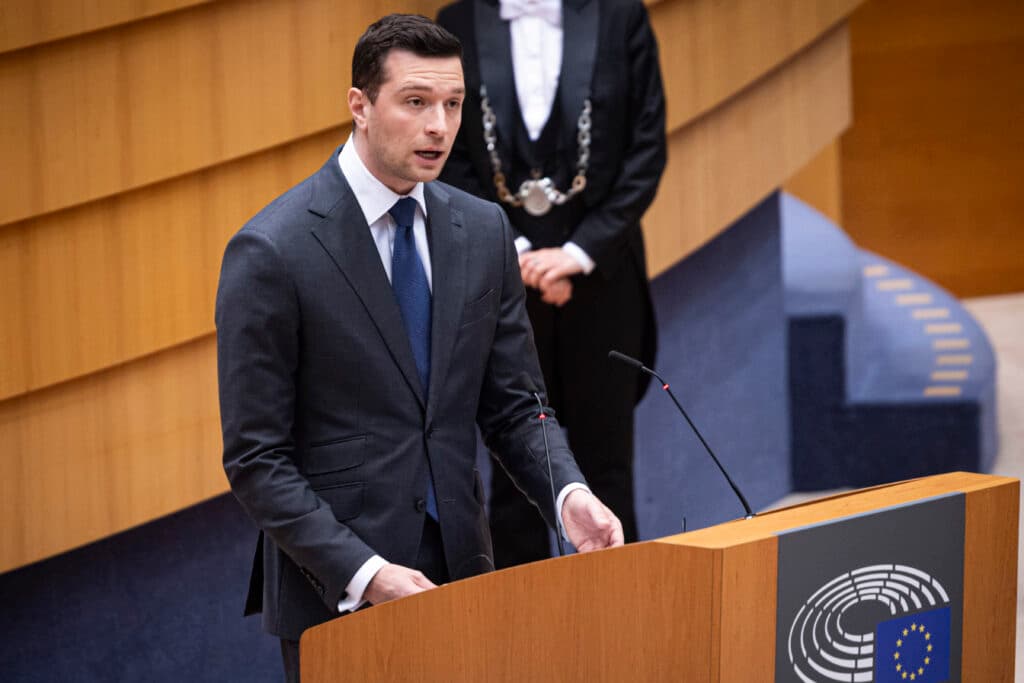
The country that in 2004 joined as part of a group of 10, mainly from the ex-Communist East, faced countless accusations of restricting democracy under Prime Minister Orbán, who also kept ties with Russia and blocked European support for Ukraine. Jordan Bardella speaks during a plenary session at the European Parliament in Brussels on March 25, 2026. | Nicolas Economou/NurPhoto via Getty Images Bringing in new members raises the prospect of admitting other “Trojan horse” capitals that could wield vetoes, which is why the Commission wants to “Hungary-proof” the enlargement process, for example by denying veto powers to new members for several years after admission.
Wary of the mood among key EU capitals, von der Leyen said Monday in the wake of Orbán’s defeat that she favors ending the bloc’s unanimity rule which, among other things, allows one capital to block any country’s accession prospects. Aggression Yet even Montenegro, which has completed nearly all the steps needed to become a new member, is finding that EU countries are stopping short of agreeing on the next stage: a mandate to start drafting the accession treaty. “It’s still in negotiations,” said the first EU diplomat.
Three Montenegrin officials, granted anonymity to discuss the sensitive process, voiced frustration about the lack of progress, pointing to France as a likely obstacle. French officials have pushed back, arguing that Paris is not alone in its concerns and wants a wider debate on enlargement. The stalemate is also problematic for Ukraine, which sees EU membership as a security guarantee against future Russian aggression. A potential peace deal with Russia could include the prospect of EU membership as early as 202