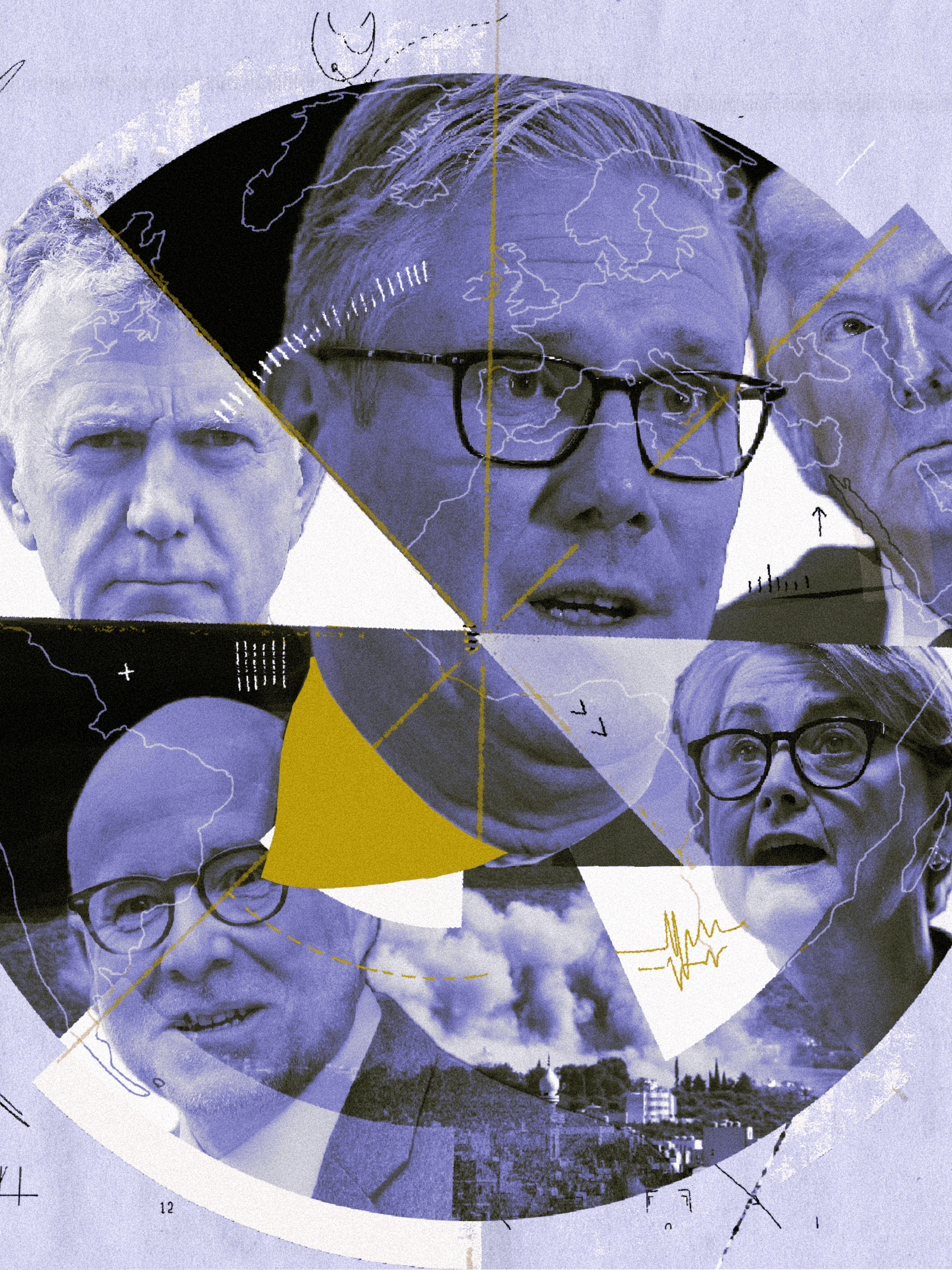
POLITICO spoke to 23 current and former U.K. government aides and politicians to map the network advising the British PM at a moment of crisis.
Inside the Starmer foreign policy team trying to survive in Trump’s world POLITICO spoke to 23 current and former U.K. government aides and politicians to map the network advising the British PM at a moment of crisis. By DAN BLOOM and ESTHER WEBBERin London Photo-Illustration by Natalia Delgado/POLITICO Keir Starmer is trying to manage Donald Trump yet again. He has a long queue of people to tell him how.
As the British prime minister tries to navigate one of the rockiest periods ever for the U.K.-U.S. special relationship, he is relying on a wide cast of characters from experts to his friends — and adjusting, reluctantly, to a world of hard power. POLITICO spoke to 23 current and former U.K. government aides and politicians, all of whom were granted anonymity to discuss internal matters, to map out the network advising Starmer on foreign policy at a time of rolling crisis. Each of them represents a different pressure on the prime minister — who is still without a permanent chief of staff.
As one government official put it: “It’s not who has the PM’s ear — it’s who has the PM’s ear on what.” The Powell supremacy No one embodies Starmer’s desire to be a fixer on the world stage more clearly than National Security Adviser Jonathan Powell, who remains a dominant force nearly 18 months after taking the job. The private feeling among some civil servants that he is “the real foreign secretary” persists, even after Starmer appointed Yvette Cooper as his second (actual) foreign secretary in September. One U.K. government official said Powell is seen as one of the sharpest operators in Starmer’s government and is used as a troubleshooter by European allies.
One European diplomat said Powell, the veteran former chief of staff to Tony Blair, “gives the direction” for No. 10 foreign policy. A person in the U.K. security community added: “When I want to know something I just pick up the phone to Jonathan Powell.” Several people who have worked with Powell — who helped shape the 1998 peace process in Northern Ireland — point to his skills as a peacemaker above all. One former government official contrasted the approaches of Powell and former No. 10 chief of staff Morgan McSweeney: “Morgan would say it doesn’t matter if we piss these people off.
Jonathan would always be more considered.” Powell was one of the handful of aides who joined Starmer on his reassurance tour of Gulf nations last week, said a person with knowledge of the trip. He negotiates on the PM’s behalf; in March he met China’s Foreign Minister Wang Yi, while in February he was spotted meeting Trump’s Special Envoy Steve Witkoff in Geneva ahead of Russia-Ukraine talks. In internal meetings, the same former official said, “Jonathan would say things like ‘Witkoff won’t like that.’ His approach is that there’s no reason to upset anyone unnecessarily — which is why Keir likes him, because he is similar.” A long-serving Whitehall official described Powell as being less about “concrete deliverables” and more about “keeping all sides happy.” The extraordinary scope of Powell’s role is rare for an unelected political adviser.
“People have been concerned about the sustainability of the arrangement since the beginning,” said one person who works with No. 10 on foreign policy. “He is essentially fulfilling the NSA role, plus the chief foreign policy advisor role and the foreign secretary role.” His behind-the-scenes influence — No. 10 blocked MPs from questioning him in public — has also raised eyebrows in some parts of Whitehall, where officials can sometimes struggle to get full information out of Downing Street. The first some senior figures knew of Powell’s recent China trip was when Beijing released the photos.
UK National Security Adviser Jonathan Powell leaves 10 Downing Street to join a meeting of the Coalition of the Willing at the Foreign Office in London on Oct. 24, 2025. | lyas Tayfun Salc/Anadolu via Getty Images As the world darkens and the Starmer-Trump relationship frays, some wonder if the PM will need to reach beyond Powell’s “peace lens,” as one official put it. Powell’s allies dismiss this as a caricature, saying he is no pacifist and peace talks involve the hardest trade-offs. But no one would doubt that the world has changed since the 1990s — including Powell himself, who said similar publicly before entering government.
Olivia O’Sullivan, director of the UK in the World Programme at Chatham House, a foreign affairs think tank, said: “In this government you see a tendency to reach back to the time last time Labour was in power, sometimes explicitly, for some of the same people, for guidance and advice, and for, in some cases, roles. But of our foreign policy guardrails and assumptions, most of the really important ones have shifted since that era.” The No. 10 team Then there is the side of Starmer watching warily how global affairs hit back home. The PM opted not to hire a separate foreign policy chief to Powell in the style of John Bew, who hel