Local studio Pérez Palacios Arquitectos Asociados has designed Barrancas, an off-grid minimalist concrete home that sits on a metal base with reflective window shutters in Mexico City. The 477-square metre (5,135-square foot) house was designed to follow the terrain, rather than impose itself on it, according to Pérez Palacios Arquitectos Asociados (PPAA). This allows the The post PPAA designs Mex
Local studio Pérez Palacios Arquitectos Asociados has designed Barrancas, an off-grid minimalist concrete home that sits on a metal base with reflective window shutters in Mexico City. The 477-square metre (5,135-square foot) house was designed to follow the terrain, rather than impose itself on it, according to Pérez Palacios Arquitectos Asociados (PPAA). This allows the heavy materials of the house to gradually emerge from its site in the western part of Mexico City.
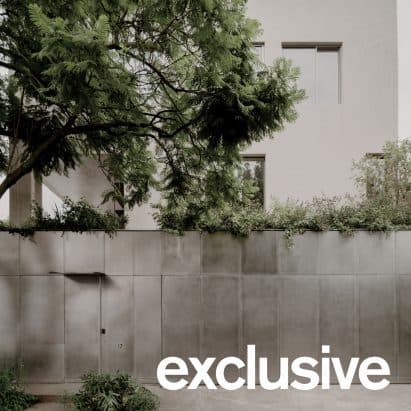
The concrete house sits above a metal base "A floating volume rests on a reflective base that amplifies light and dissolves its weight, reinforcing a balance between solid and void while gradually becoming part of its surroundings," studio founder Pablo Pérez Palacios told Dezeen. The ground level is wrapped in muted nickel-toned metal that amplifies the surrounding greenery into diffused reflections, while window shutters in the same material add privacy. The cladding conceals the home's main entrance and garage, while creating the appearance that the upper levels float above the vegetation.
Metal shutters add privacy on the ground level The upper volume – the first and second levels, which contain bedrooms and a large study – is a cube set back from the ground floor perimeter and presents as a solid, contained form. Completed in grey concrete with a raked plaster finish, the volume is matte and opaque, punctuated by controlled, rectangular windows. The house's upper levels are shaped like a cube "Its materiality is further accentuated through a texture of vertical striations achieved with the same plaster finish, reinforcing a clean, sober and timeless geometry," the studio said.
Inside the perimeter wall, the ground floor opens up to a large rear garden. The fluidity between inside and outside is further enforced by a large street-front planter that integrates a jacaranda tree into the architecture. Read: PPAA utilises "subtractive design" for concrete house in Los Angeles "In this way, the house avoids a traditional reading of closed, defensive architecture in relation to the urban environment," PPAA said.
"Instead, the ground floor is perceived more as a landscape project than as an autonomous architectural object, blurring its physical boundaries through the strategic incorporation of vegetation both inwardly and toward the street." Barrancas features a hidden garden and a green terrace On the middle level, the conditioned space retreats into the cube, creating a linear terrace without breaking the silhouette of the house. "This void generated by the displacement of the volume aligns with PPAA's philosophy, in which unbuilt space – or the defined void – acquires the same design relevance as the built volume, understanding architecture as the simultaneous construction of matter and space," the studio said.
Natural plaster walls add to the calm material palette Inside the home, natural plaster walls complement bush-hammered marble flooring in the public areas of the house and warmer wood finishes in the private quarters. The design operates independently from the electrical grid, using solar panels to power water heating and cooking systems. "Likewise, special care was taken during the construction process in the selection of low–carbon-footprint materials, understanding sustainability not only as a technological issue, but as a comprehensive project stance," the studio said.
Warm wood was used for the bedrooms Recently, PPAA has completed a concrete house with a "subtractive design" in Los Angeles, California, a rammed earth guest house that blends into the terrain of the Baja Peninsula and a stucco house with terraces that open to the forest of the Valle de Bravo in Mexico. The photography is by Luis Garvan. Project credits: Studio: PPAA Team: Pablo Pérez Palacios, Emilio Calvo, Miguel Vargas, Adán García, Andrés Domínguez, Nancy Estevez, Marcelino Pacheco, Jonathan Reséndiz