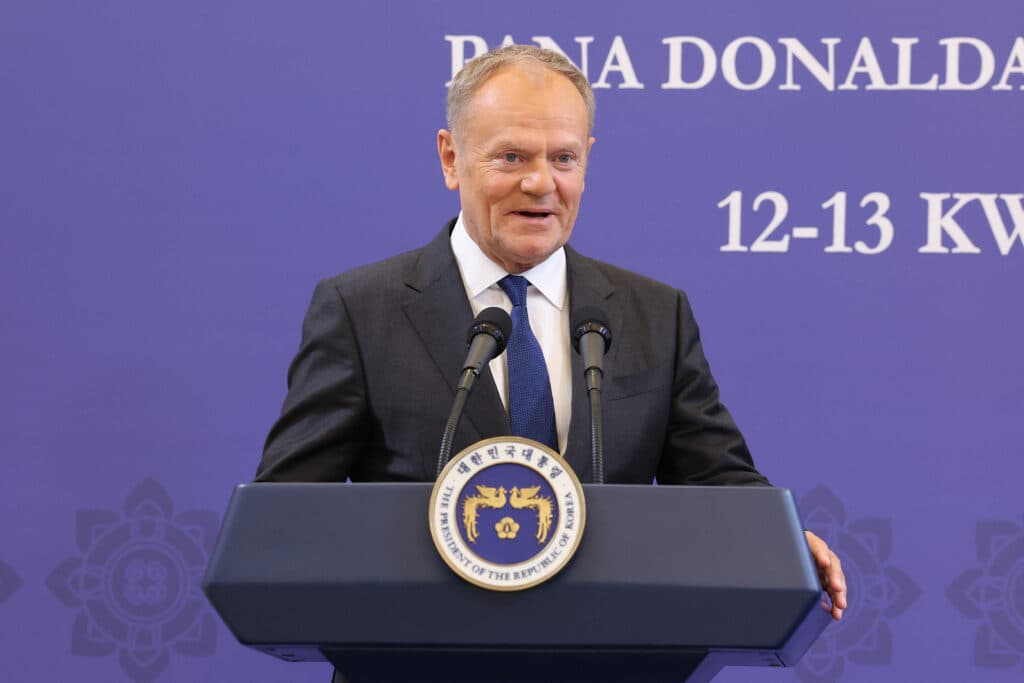
Polish PM Donald Tusk is crowing that Péter Magyar's victory is also a win for him, while the right works out how to distance itself from Orbán.
WARSAW — Victor Orbán’s stunning defeat in Sunday’s Hungarian election is forcing Poland’s nationalist right to calculate what lessons to draw from Budapest ahead of its own key election next year. Poland’s Law and Justice (PiS) party and Orbán’s Fidesz government have very similar political playbooks: They are close friends with U.S. President Donald Trump and his MAGA movement, they are deep skeptics of the European Union, and they support the model of “illiberal democracy” that had been a hallmark of Orbán’s 16 years in power.
Orbán was backed by Trump and Vice President JD Vance personally campaigned for him. Polish President Karol Nawrocki also visited Budapest, while PiS leader Jarosław Kaczyński painted a loss for the Hungarian PM in apocalyptic terms for the European right. None of that prevented Orbán’s defeat, and now the Polish right is worried that its hopes of toppling liberal Prime Minister Donald Tusk in next year’s parliamentary election are receding.
Tusk made a point of hammering home that the victory of Hungarian opposition leader Péter Magyar was a win for him too. “I’m so happy. I think I’m happier than you,” Tusk said when he called Magyar to congratulate him.
Meanwhile, PiS MP Michał Wójcik grumbled: “What should I be happy about?” Tusk framed the political change in Budapest as one that will have an impact across Europe. “Everyone feared there was a trend … toward authoritarian, corrupt regimes. That is not the case,” Tusk told a press briefing while in Seoul on an official visit.
“I am glad this part of Europe is showing that we are not condemned to rule by corrupt and authoritarian governments.” “I’m so happy. I think I’m happier than you,” Donald Tusk said when he called Magyar to congratulate him. | Chung Sung-Jun/ AFP via Getty Images) Magyar has already announced that his first foreign trip will be to Warsaw. The Tusk government hopes for a European realignment with Magyar, deputy Defense Minister Cezary Tomczyk told POLITICO in a text message, saying: “The Hungarian government will be our strategic partner.” Reassessing Orbán A sense that going all-in for Orbán might have been a mistake is dawning in PiS.
The Polish right is distancing itself from Orbán and highlighting that his close alliance with Russia was a big problem in Warsaw. “[Orbán] was an ally of Poland only in the contest with cosmopolitans and centralizers in the EU and on migration. That was important, but not enough,” Sławomir Cenckiewicz, the head of Nawrocki’s National Security Bureau, wrote on social media.
The Hungarian PM had “a different perception of the Russian threat, differences over NATO, … and an energy policy entirely at odds with our interests,” he added. Tobiasz Bocheński, a PiS member of the European Parliament, said: “As for Viktor Orbán’s eastern policy, I have repeatedly stated that it was completely at odds with ours.” Key figures in the PiS camp are either quiet or issuing uncontroversial congratulations to Magyar, while trying to change the subject in Warsaw by shifting to domestic issues. The party’s X feed on Monday was dominated by attacks on Tusk over health care, without a single mention of the Hungarian result.
PiS was counting on Orbán to hang on. Kaczyński spelled out his vision of a pan-European right-wing sweep anchored by a triumphant Orbán, followed by PiS ousting Tusk and National Rally leader Jordan Bardella taking power in France in 2027, while Giorgia Meloni continues to rule in Italy. “A force of this kind could emerge that would truly begin to change Europe,” Kaczyński told Hungary’s Mandiner magazine before the election.
“And this is very, very much needed. The European Union is currently in a severe crisis that could lead to its collapse.” However, Bocheński argued that the European right shouldn’t despair. “I think those who say this will halt the right-wing wave sweeping across Europe are greatly exaggerating.” Rather than focusing on Europe, PiS has to concentrate on unseating Tusk, whose Civic Platform party has been gaining ground on it for months, according to POLITICO’s poll of polls.
The party also has to figure out if it can distance itself from Trump in a country that is still strongly pro-American. “Trump’s endorsement seems to have contributed to the extent of Orbán’s defeat — it certainly didn’t help,” said Ben Stanley, a political scientist at the SWPS University in Warsaw. “It will concentrate minds among PiS strategists on how much Trumpism can help them.” That leaves the Polish right with a dilemma on how strongly to break with the way Orbán campaigned.
Aleks Szczerbiak, a professor at the University of Sussex who studies Polish politics, argued that Tusk will likely be very careful in building a campaign around PiS’s fondness for Trump for fear of damaging Polish-U.S. relations. However, he may wait and see if his political rivals “dig that hole for themselves” over the U.S. president.