William Wegman: Video Works, 1970-197724th April, 2026 – 30th May, 2026HUXLEY-PARLOUR3-5 Swallow StreetLondon William Wegman’s Early Video Works Return at Huxley-Parlour, as Video Works, 1970–77 Traces His Wit, Linguistic Play and the First Appearances of His Weimaraner Collaborator, Man Ray Huxley-Parlour presents Video Works, 1970–77, an exhibition of early video works by the American artist Wil
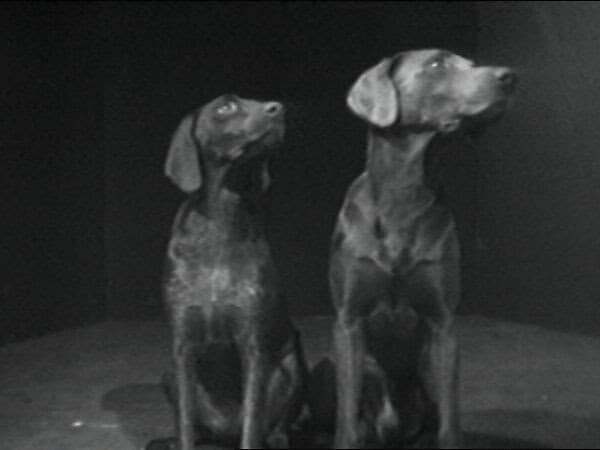
liam Wegman. Bringing together ten films made during the 1970s, the show focuses on the qualities that made Wegman’s moving-image practice so singular: a feel for language, wordplay, visual puns, comedy and narrative economy. It also includes some of the earliest examples of his collaborations with his Weimaraner, Man Ray.
After relocating to Los Angeles in 1970, Wegman developed his work within the emerging field of West Coast Conceptualism. While East Coast Conceptual practices often centred on more codified relationships between text and image, their West Coast counterpart adopted a different register, one rooted in absurdity, the vernacular and humour. Wegman’s videos belong firmly to that turn.
They are precise yet open, intellectually alert without forfeiting accessibility. The artist has said of his video works: ‘when I first started working, I was really striving for clarity. What I liked about my videos was that my mother would like them, my neighbor would like them, anybody would like them.
Whereas with other works of mine, you’d perhaps have to know something, be schooled in something. The videos just seemed to break through.’ William Wegman, Still from Dog Duet, 1975 Courtesy of HUXLEY-PARLOUR That clarity is key to the exhibition. Some works hinge on the mechanics of the double entendre, drawing out the slippage between what is said and what is seen.
Others turn to the formats of mass media, sending up the tone, pace and commercial instincts of broadcast culture through deadpan sales pitches and telemarketing routines. In each case, Wegman treats language not as a stable system but as something elastic, fallible and quietly comic. His collaborations with his Weimaraners complicate matters further, especially where performance and authorship are concerned.
In an early, unplanned sketch, Man Ray chews at Wegman’s sound equipment, shifting from subject to agent in the space of a single gesture. The dog becomes not merely a performer but a generative presence within the work itself. Across the exhibition, these exchanges sharpen the artist’s enduring interest in the porous boundary between the everyday and the absurd.
The curator Doug Eklund identified an emphasis on ‘failure as aesthetic strategy’ within West Coast Conceptualism. In Wegman’s practice, humour gives that strategy its shape and bite. It thrives on mismatch, anticlimax and apparent inconsequence, using comic restraint to expose deeper instabilities in communication and representation.
As the art critic Kim Levin asserts, it reveals ‘the failure of words to correspond to images, feelings to expressions, actions to results.’ At Huxley-Parlour, Video Works, 1970–77 positions William Wegman’s early video art not as a sidelight to his wider practice, but as a vital contribution to Conceptual art in 1970s America. These works remain fresh because they understand something enduring about images and language: that meaning is never entirely settled, and that humour can be one of art’s most exacting tools. William Wegman: Video Works, 1970-1977 open the 24th of April, 2026 until the 30th of May, 2026 at HUXLEY-PARLOUR Learn more ©2026 HUXLEY-PARLOUR